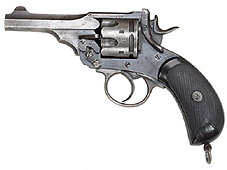
The guns issued to senior officers were MkIV, .455 calibre, short-barreled and nickel-plated revolvers. Hatched plaques of composite material are applied to either side of the butt which has a rounded end and a lanyard ring fitted. The frame is solid with the barrel. The cylinder is chambered for six rounds. Double action. The barrel is rifled and fitted with a blade foresight. The calibre is 0.455in.
Date made: c.1899
Artist/Maker: Webley & Scott Revolver & Small Arms Co.
Place made: Birmingham, West Midlands, England
Credit: National Maritime Museum, Greenwich, London
Measurements: 160 x 280 x 30 mm
For more information on the guns issed and their use aboard Titanic refer to this article here.
Shooting and Suicide Witnesses - An Overview
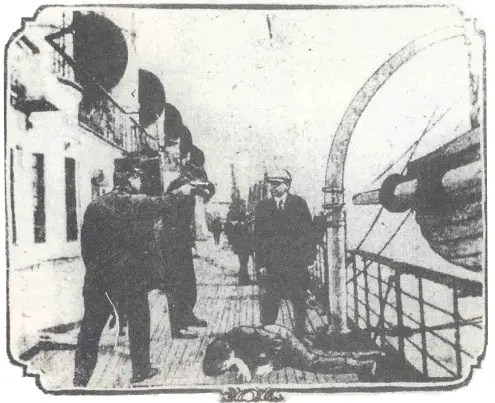
Actors dramatise a scene of an officer shooting steerage passengers, standing over the body of a man he has shot. (Denver Post File -source)
There are - maybe surprisingly - quite a number of witnesses who mention a suicide or shooting and/or use of a gun on that fateful night. This page attempts to list them all and is being regularly updated as more evidence comes to light. The names are listed in alphabetical order, with unknown names listed at the end. Click on each name to discover more information about the person and an analysis of the accuracy or reliability of their account.
Each witness account will be analysed and based on present available information divided into the following catagories:
Please note: This page and many connected pages are still under construction. The author also gratefully acknowledges the following in compiling the shooting/suicide witnesses list:
Bill Wormstedt
George Behe
George Jacub
Ioannis Geogiou
Senan Molony
Named Suicide Accounts (34)
Accounts of a suicide by witnesses who can be identified by name Click on their image or name to find out more about each account:
" stood by with drawn revolver...threatened to shoot"
Watt, Elizabeth
Second class
Master at arms
"The master at arms was standing with a gun."
Wennerstrom, August
Third Class passenger
Someone
"Fired a pistol at all who tried to climb aboard."
White, Alfred
Crew
Unknown
"We heard some fifteen or twenty shots from the rail of the ship"
Woolner, Hugh
First Class passenger
Someone
"Collapsible C... pistol flashes."
Other Unnamed Shooting Accounts (4)
Accounts involving the use of gun(s) or shooting(s) by unidentified persons
Source
Status
Who
Account
The New York Times
German woman
Unknown
"She said he was shot, insisting on it"
"Voices from the Titanic"
Seaman
Chief Officer
"Shoot at two Italians ...the officer shot one of them."
Daily Sketch
Unknown
Murdock
"I saw Mr. Murdock shoot down an Italian."
Manchester Guardian
Seaman
Chief Officer
"Saw the chief officer shoot an Italian passenger."
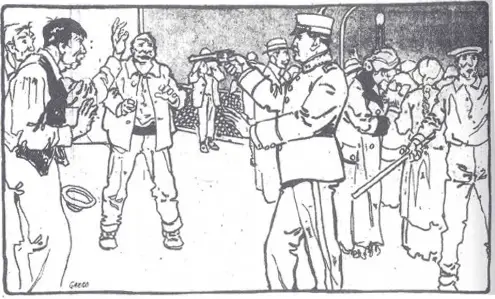
In this line sketch of an early rumour, Major Archibald Butt, President Taft’s military aide, points a revolver at third-class passengers. (Denver Post File -source)
Notes
In a chapter entitled “Shots in the Dark,” Walter Lord writes in his book The Night Lives On:
“Through the years there have also been stories of actual shootings, but serious students have largely written them off as the concoctions of a sensationalist press that stopped at nothing for dramatic effect. I have always gone along with this reasoning.”(21.)
His attitude changed upon the discovery of Eugene Daly’s and George Rheim’s letters. After relating their evidence he wrote:
“These strikingly similar accounts come from completely independent sources. There’s no reason to suppose that Eugene Daly and George Rheims were ever in touch. Both were writing a private letter to an intimate member of the family, not an account for the press. Both were writing immediately after the event, not years later when fantasy might have taken over. They had absolutely no reason to fabricate, but every reason to be telling the truth as far as they saw it… The whole incident can’t be verified, yet can’t be dismissed. It was not just one more lurid tale appearing in the yellow press; it was witnessed and independently described by two separate firsthand sources. It must be taken seriously, but beyond that, it remains a mystery.” (Walter Lord, The Night Lives On(21.))
The above accounts have various shades of reliability, but the author puts forward the proposition for the sake of simplicity that the strongest evidence is from Rheims, Daly and Svensson, whose accurate testimony holds up to scrutiny, both being on the boat deck at the right time and writing independent yet complimentary accounts in the form of personal letters and reports soon after the event. Daly may have the ‘edge’ in that he also testified at the 1915 Limitation of Liability hearings. We can most certainly eliminate "Dittmar-Pittman" as well as possibly the accounts of Chevré, Francatelli and McGough. The remaining 27 accounts have shades of possibility. Hichens and Mr. Toppin, in light of their positions, provide surprising support.
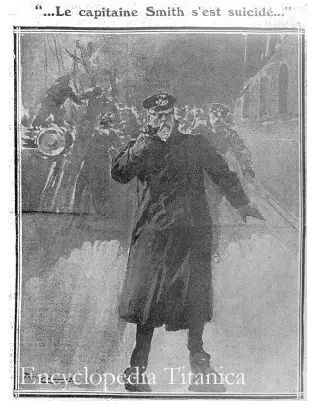
French paper L'Excelsior, 20 April 1912, drawing by Paul Thiriat, depicts Captain Smith's alleged suicide. (8.)
Many of the accounts could well be unsubstantiated rumour (i.e. “second-hand”) but should not be simply discounted as such. While the term ‘rumour’ has negative connotations, in the context of the first-hand testimony that specifically mentions suicide, there is no reason to out-rightly discard it as malicious gossip. It confirms that a fairly large number of people from a variety of backgrounds were relating experiences that included seeing a shooting/suicide.
However, it must be maintained that even with this substantial number of accounts, there is still not enough evidence to put forward the alleged suicide as fact. What may have started as a rumour from a bitter survivor could have been transformed and cross-pollinated into fact in the minds of the eyewitnesses whose innocent observations –in their minds- fit into the equation. In the aftermath of the disaster and due to the lack of rapid communication, full details not exposed until many days after the event, much rumour and speculation existed, with completely false stories perpetrated as fact.
While the volume of evidence resulting from an event that took place in Titanic’s last moments is not expected to be great, with most observers being among the 1500 who perished in the sea, there is still not sufficient detail and reliability to confirm the incident. However, there is enough evidence to confirm one vital point: First Officer Murdoch’s suicide or that of the other officers cannot be completely ruled out. There is a possibility that an alleged suicide did take place. By also reviewing the research put forward in defence of the allegations a more comprehensive understanding of the situation can be achieved (refer to "Alternative Accounts").